Cast Gallery catalogue number: A141m
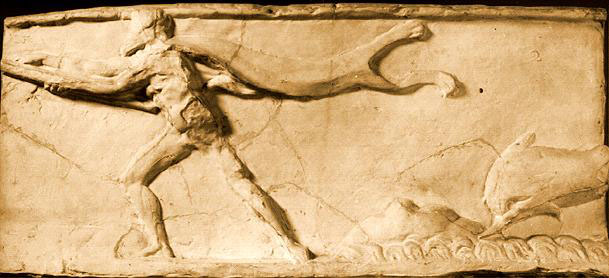
Bearded satyr, cloaked in a panther skin and armed with a torch, running to the left.
The front half of a dolphinman is shown to the right.
- Plaster cast: Height: 27cm.
- Copy of part of a marble frieze.
- The frieze:
- is from the Lysikrates Monument in Athens.
- was made about 330 BC.
- is still in situ.
Detailed Record
Commentary Prepared by Dr. Julia Lenaghan, Ashmolean Museum
A 141 M
Satyr and Dolphin; Lysikrates Monument
Marble (Pentelic)
Frieze
H 25.4 cm
Greece, Athens, in situ
After 335/34 BC; Late Classical
Preservation:The surface of the relief is heavily worn, the left hip of the satyr with a part of the upper left leg broken away.
Description:Depicted is a bearded satyr in wide stance facing to the left. His arms are thrust forward and hold a long branch. A panther skin is tied around his neck and flows behind his back. His head extends over the upper frame of the relief. Further to the right is the frontal part of a dolphin. Here, the ground is characterized by wavy lines with a rock behind.
Discussion:The satyr depicted here gives chase to a pirate further to the left (A 141l), brandishing a weapon in form of a long branch. Behind him is another pirate, already turned into a dolphin. Waves in the foreground with a rock behind indicate spatial depth.
For a full discussion of the monument see A 141a.
Bibliography:H. F. de Cou,
"The Frieze of the Choregic Monument of Lysicrates at Athens." (AJA 8 1893) 42-55
Discusses earlier studies and drawings of the monument and the composition of the frieze.W. Erhardt,
"Der Fries des Lysikratesmonuments" (Antike Plastik 22 1993) 20 figs. 21; 23 pl. 11
The most thorough discussion of the frieze so far. Excellent photographs of the original frieze, as well as documentation of early drawings and casts documenting a much better state of preservation. Extensive bibliography.